 Português (PT)
 English (EN)
 Español (ES)

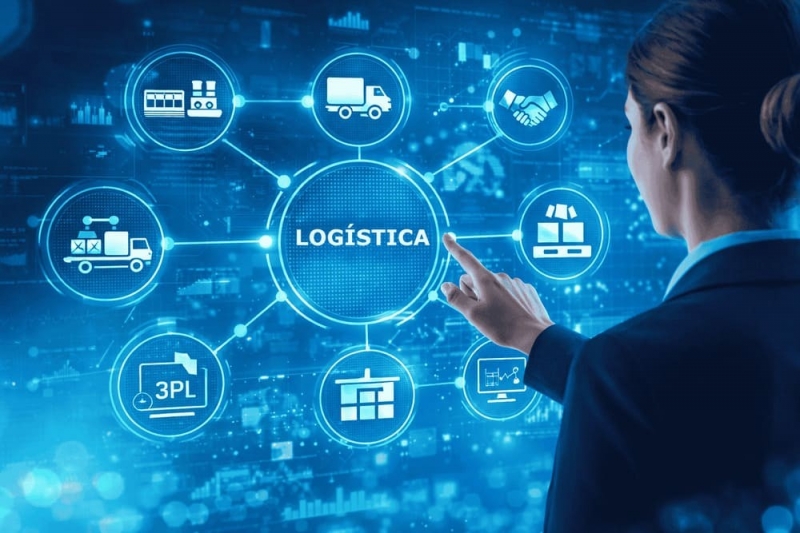
Artificial intelligence is no longer just a trend: it is a concrete tool that is redefining the efficiency, speed and reliability of logistics operations. In the logistics sector, this has a direct impact on costs, delivery times and customer experience. In this article, you will understand what AI in logistics is, what the main practical applications are and how your company can start taking advantage of these benefits.
What is artificial intelligence in logistics
Artificial Intelligence in logistics is the use of technologies that allow systems to learn from data, identify patterns and make decisions or suggest decisions faster and more accurately than a human could do alone. In practice, this means that algorithms can analyze large volumes of historical sales and transport data, identify demand trends and customer behavior, forecast problems in the supply chain such as delays, stockouts or route overload, and suggest or even automatically execute actions such as stock replenishment, route changes or priority deliveries. The combination of AI with Machine Learning and with IoT devices such as sensors and trackers creates the concept of Logistics 4.0, an evolution towards more autonomous, connected and intelligent operations.
Demand forecasting and stock planning
AI algorithms analyze historical sales data, market trends, seasonality and even external variables such as weather or economic events to estimate future demand with much greater precision. This enables a more balanced stock with fewer ruptures and less excess of idle products, better planning of purchases and production and reduced costs for warehousing and obsolescence. For companies operating in multiple municipalities or regions that need to deliver materials, kits and samples, this forecasting capability can be a major competitive advantage.
Route and transport optimization
AI is used to calculate more efficient routes considering real traffic, weather conditions, vehicle constraints such as size, weight and dimensions, and delivery deadlines and customer priorities. With Machine Learning, the system not only calculates routes, but also learns from past experiences, identifying which routes worked well, which generated delays and automatically adjusting future suggestions. This leads to reduced fuel costs, shorter delivery times, better fleet utilization and greater predictability for the end customer.
Real-time stock management
With IoT sensors integrated with AI algorithms, stock levels can be monitored in real time at different points in the chain, such as distribution centers, stores and sales points. AI automatically identifies when replenishment is needed, suggests replenishment quantities and alerts on risks of stockouts or excess. This reduces the need for human estimates for replenishment and decreases operational errors, making the process more reliable and agile.
Data analysis and decision making
AI transforms raw data into actionable insights, enabling intelligent dashboards that show a complete view of the supply chain, performance patterns of routes, carriers and distribution centers and risk indicators such as probability of delays, accidents or equipment failures. Logistics managers can thus make more informed and faster decisions, based on projected scenarios and not only on past experiences.
Fleet monitoring and safety
AI systems applied to fleet management can monitor fuel consumption, analyze driver behavior such as harsh acceleration, route deviations and speeding, and identify patterns that indicate a higher probability of accidents. With this, the company can offer more targeted training, reduce accident rates and lower maintenance and fuel costs, increasing the safety and efficiency of the operation.
Benefits of AI for logistics operations
The adoption of AI in logistics brings concrete benefits that can be translated into numbers and results. There is a reduction in operating costs through optimized routes, lower fuel consumption, better fleet use and more balanced stock. Efficiency increases with automated processes, faster decisions and operations with fewer human errors. Customer experience improves with faster, more predictable deliveries and greater transparency. Complete visibility of the chain is achieved through dashboards that show in real time the status of each stage of the logistics process. The operation becomes more resilient, with the ability to anticipate problems and react more quickly to changes in the market or in demand.
Challenges to implementing AI in logistics
Despite the benefits, implementing AI requires attention to some fundamental points. Data quality is crucial, as AI depends on consistent, organized and up-to-date data, and if operational data are fragmented or inconsistent, results can be limited. Integration between systems is another challenge, as many companies still operate with multiple systems such as ERP, TMS and WMS that do not communicate well, and AI needs an integrated view to work properly. Team training is also essential, as operational teams and managers need to understand how to use the new tools, interpret dashboards and make decisions based on insights generated by AI. Initial investment is necessary, as although the cost of some AI solutions has decreased, there is still investment needed in technology, infrastructure and training.
How your company can start using AI in logistics
A practical path to start is to identify a clear problem, such as routes with many delays, very high stock in some products or difficulty forecasting demand in certain periods. Then you need to assess the quality of your data, checking whether sales, transport, stock and production data are available, organized and reliable. Selecting an appropriate AI solution is the next step, and there are TMS and WMS platforms with built-in AI features such as demand forecasting, route optimization and intelligent stock management. Implementing a pilot project allows you to start with a controlled operation, such as a region, a product type or a specific customer, to validate results before expanding. Team training and process adjustment are fundamental, as technology only generates value if people use it correctly and processes are adapted to leverage AI insights.
Conclusion: AI as a competitive differentiator in logistics
Artificial intelligence in logistics is, today, one of the main ways to compete in a market where agility, costs and reliability are decisive factors. Companies that already adopt these technologies are managing to reduce operating costs, increase operational efficiency, improve customer experience and build more resilient and predictable operations. For companies like Vottax, which operate in a dynamic and demanding market, investing in AI in logistics can be exactly the differentiator that separates those who deliver with quality and speed from those who simply keep the pace.
No comment. Be the first to comment!